One camera frame, several questions at once: where is the lane, where can we drive, where are the cars, what is the light doing. A separate network per question would run the same early vision again and again.
Picture one cook and three dishes on the pass — lane mask, vehicle grid, traffic-light class. The cook is the shared trunk: one forward pass through the early convolutions. Each dish is a head. The repo plates a fourth dish too, freespace, from the same cook; we do not pretend there are only three.
The course code lives in modules/02_hydranet/. Loss balancing uses UncertaintyMultiTaskLoss in multitask_loss.py.
Each idea shows up three times: a picture, a handful of numbers, then code. Predict first, then run the cell. The paragraph after each cell says what is weird, and what it would mean for a car.
import os, subprocess, sys
from pathlib import Path

try:
    import torch
except ImportError:
    subprocess.run(
        [sys.executable, "-m", "pip", "install", "-q", "torch",
         "--index-url", "https://download.pytorch.org/whl/cpu"],
        check=True,
    )
    import torch
try:
    import matplotlib
    import matplotlib.pyplot as plt
    import numpy as np
except ImportError:
    subprocess.run([sys.executable, "-m", "pip", "install", "-q", "matplotlib"], check=True)
    import matplotlib
    import matplotlib.pyplot as plt
    import numpy as np

import torch.nn as nn
import torch.nn.functional as F

def keep_inline():
    matplotlib.use("module://matplotlib_inline.backend_inline", force=True)
    ip = None
    try:
        from IPython import get_ipython
        ip = get_ipython()
    except Exception:
        ip = None
    if ip is not None:
        ip.run_line_magic("matplotlib", "inline")

%matplotlib inline

def find_repo(start: Path) -> Path:
    for p in [start, *start.parents]:
        if (p / "modules" / "02_hydranet" / "heads.py").is_file():
            return p.resolve()
    return start.resolve()

REPO = find_repo(Path.cwd())
if not (REPO / "modules" / "02_hydranet" / "heads.py").is_file():
    dest = Path.cwd() / "self-driving-ai-course"
    if not (dest / "modules" / "02_hydranet" / "heads.py").is_file():
        subprocess.run(
            ["git", "clone", "--depth", "1", "https://github.com/vvknyn/self-driving-ai-course.git", str(dest)],
            check=True,
        )
    REPO = dest.resolve()

os.chdir(REPO)
MOD = REPO / "modules" / "02_hydranet"
sys.path.insert(0, str(MOD))

from backbone import HydraNetBackbone
from heads import (
    FreespaceHead,
    HydraNet,
    LaneSegmentationHead,
    TrafficLightHead,
    VehicleDetectionHead,
)
from multitask_loss import UncertaintyMultiTaskLoss

def nparams(module):
    return sum(p.numel() for p in module.parameters())

print("Repo:", REPO)
keep_inline()
Repo: /tmp/course
The setup cell points Python at modules/02_hydranet/ on disk. On Colab it clones the course repo only when that folder is missing. For a car stack, the important part is the same: one process loads one copy of the shared trunk code, then four heads attach to it.
1. When one loss shouts over the others
Naive training adds every task loss into one number and backpropagates. The huge loss owns the gradient on the shared trunk. The small loss barely nudges the same weights — lane paint can stop updating while the vehicle head yells.
Below we measure how much of the first convolution's update each job owns on one synthetic batch (seed 42, same shapes as break_it_fix_it.py). Then we turn the volume knob on the loud job and measure again.
Predict: before any weighting, the vehicle share of that stem gradient will be above 90 percent. After setting the vehicle log-variance to 3.5, the lane share will rise above 0.34 percent but the vehicle share can stay well above half.
torch.manual_seed(42)
drill_images = torch.randn(4, 3, 128, 256)
drill_lanes = (torch.rand(4, 1, 128, 256) > 0.95).float()
drill_vehicles = torch.randn(4, 5, 16, 32) * 5.0
drill_model = HydraNet()
drill_preds = drill_model(drill_images)
drill_lane = F.binary_cross_entropy_with_logits(drill_preds["lane"], drill_lanes)
drill_veh = F.mse_loss(drill_preds["vehicles"], drill_vehicles)
stem_w = drill_model.backbone.stem[0].weight
g_lane = torch.autograd.grad(drill_lane, stem_w, retain_graph=True)[0].norm().item()
g_veh = torch.autograd.grad(drill_veh, stem_w, retain_graph=True)[0].norm().item()
lane_share = 100.0 * g_lane / (g_lane + g_veh)
veh_share = 100.0 * g_veh / (g_lane + g_veh)

balancer = UncertaintyMultiTaskLoss(2)
with torch.no_grad():
    balancer.log_vars.copy_(torch.tensor([0.0, 3.5]))
weights = balancer.get_task_weights()
balanced_total = balancer([drill_lane, drill_veh])
g_lane_w = torch.autograd.grad(weights[0] * drill_lane, stem_w, retain_graph=True)[0].norm().item()
g_veh_w = torch.autograd.grad(weights[1] * drill_veh, stem_w, retain_graph=True)[0].norm().item()
lane_share_w = 100.0 * g_lane_w / (g_lane_w + g_veh_w)
veh_share_w = 100.0 * g_veh_w / (g_lane_w + g_veh_w)

print("lane loss", f"{drill_lane.item():.4f}")
print("vehicle loss", f"{drill_veh.item():.4f}")
print("lane stem share before", f"{lane_share:.2f}")
print("vehicle stem share before", f"{veh_share:.2f}")
print("log_vars", [f"{v:.1f}" for v in balancer.log_vars.detach().tolist()])
print("lane weight", f"{weights[0]:.4f}")
print("vehicle weight", f"{weights[1]:.4f}")
print("balanced total", f"{balanced_total.item():.4f}")
print("lane stem share after", f"{lane_share_w:.2f}")
print("vehicle stem share after", f"{veh_share_w:.2f}")
assert veh_share > 90.0
assert lane_share_w > lane_share
assert veh_share_w < veh_share

labels = ["before weighting", "after volume knob"]
x = np.arange(len(labels))
width = 0.35
fig, ax = plt.subplots(figsize=(7, 3.8))
ax.bar(x - width / 2, [lane_share, lane_share_w], width, label="lane")
ax.bar(x + width / 2, [veh_share, veh_share_w], width, label="vehicle")
ax.set_ylabel("percent of stem gradient")
ax.set_title("How much of the shared-trunk update each job owns")
ax.set_xticks(x, labels)
ax.legend()
plt.tight_layout()
plt.show()
lane loss 0.6553
vehicle loss 25.0871
lane stem share before 0.34
vehicle stem share before 99.66
log_vars ['0.0', '3.5']
lane weight 0.5000
vehicle weight 0.0151
balanced total 2.4564
lane stem share after 10.11
vehicle stem share after 89.89
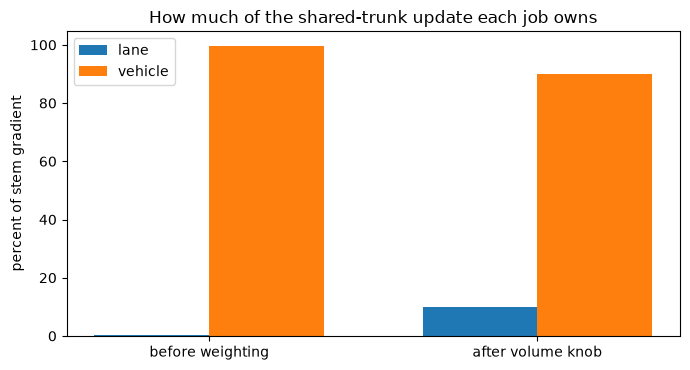
Lane loss is 0.6553. Vehicle loss is 25.0871 — almost forty times larger on this batch. Before weighting, lane owns 0.34 percent of the stem gradient and vehicle owns 99.66 percent. The bar chart is the whole story: one dish is shouting and the other is whispering into the same cook.
Turning the volume knob sets vehicle log_vars to 3.5. Lane weight stays 0.5000; vehicle weight drops to 0.0151. Balanced total is 2.4564. After weighting, lane share rises to 10.11 percent and vehicle share falls to 89.89 percent. Vehicle still leads, but lane is no longer invisible. On a real car, that invisible lane gradient is how you get a network that chases boxes and drifts on paint.
2. Shared trunk
HydraNetBackbone runs three stride-2 stages and returns a dictionary p1, p2, p3. The cook's prep station: three feature maps at different resolutions.
Input for this pass: a synthetic batch (2, 3, 128, 256). There is no image file in this module. The tensor is random, and the shapes do not depend on the pixel values.
Predict: p1 keeps 32 channels at half resolution, p2 keeps 64 channels at quarter resolution, and p3 keeps 128 channels at one eighth. Height 128 divided by 8 is 16. Width 256 divided by 8 is 32.
torch.manual_seed(0)
images = torch.randn(2, 3, 128, 256)
backbone = HydraNetBackbone()
feats = backbone(images)
print("input", tuple(images.shape))
for name in ("p1", "p2", "p3"):
    print(name, tuple(feats[name].shape))
print("p3 height", images.shape[2] // 8, "p3 width", images.shape[3] // 8)
assert tuple(feats["p1"].shape) == (2, 32, 64, 128)
assert tuple(feats["p2"].shape) == (2, 64, 32, 64)
assert tuple(feats["p3"].shape) == (2, 128, 16, 32)
input (2, 3, 128, 256)
p1 (2, 32, 64, 128)
p2 (2, 64, 32, 64)
p3 (2, 128, 16, 32)
p3 height 16 p3 width 32
The input is (2, 3, 128, 256). p1 is (2, 32, 64, 128), p2 is (2, 64, 32, 64), and p3 is (2, 128, 16, 32). The last lines read p3 height 16 and p3 width 32, which is the input divided by 8. Every head reads from this pyramid; p3 is also stored as backbone_features for the next module (depth and BEV come later).
3. One trunk vs cloned trunks
Count parameters with the repo classes. Three jobs — lane mask, vehicle grid, traffic light — can each own a full backbone. The shared design keeps one backbone and three heads. Freespace adds a fourth head on that same trunk.
Predict: three separate trunks cost about twice one shared trunk plus those three heads, because the backbone is most of the weight and the heads are not free.
backbone_n = nparams(HydraNetBackbone())
lane_n = nparams(LaneSegmentationHead())
free_n = nparams(FreespaceHead())
vehicle_n = nparams(VehicleDetectionHead())
light_n = nparams(TrafficLightHead())
separate3 = 3 * backbone_n + lane_n + vehicle_n + light_n
shared3 = backbone_n + lane_n + vehicle_n + light_n
separate4 = 4 * backbone_n + lane_n + free_n + vehicle_n + light_n
hydranet_n = nparams(HydraNet())
print("backbone", backbone_n)
print("lane head", lane_n)
print("freespace head", free_n)
print("vehicle head", vehicle_n)
print("traffic light head", light_n)
print("three separate models", separate3)
print("one trunk + three heads", shared3)
print("separate / shared", f"{separate3 / shared3:.4f}")
print("four separate trunks", separate4)
print("HydraNet", hydranet_n)
print("parameters saved", separate4 - hydranet_n)
assert separate3 > shared3
assert hydranet_n == shared3 + free_n
assert separate4 - hydranet_n == 3 * backbone_n
backbone 288800
lane head 264417
freespace head 172161
vehicle head 74117
traffic light head 8516
three separate models 1213450
one trunk + three heads 635850
separate / shared 1.9084
four separate trunks 1674411
HydraNet 808011
parameters saved 866400
The backbone is 288800 parameters. The lane head is 264417, the vehicle head is 74117, and the traffic-light head is 8516. Three separate models are 1213450 parameters. One trunk plus those three heads is 635850. The ratio is 1.9084.
Freespace adds 172161 parameters. Four separate trunks are 1674411. The real HydraNet is 808011. The line parameters saved is 866400, which is three backbones you do not allocate. On an embedded GPU, that saved memory is what makes multitask perception feasible at all.
4. Four heads from one forward
HydraNet.forward runs the trunk once, then each head. Lane is the only head that concatenates p1 and p2 back in as skip connections. Freespace upsamples p3 alone. Vehicles stay on the stride-8 grid with 5 channels. Traffic light pools p3 down to one vector and emits 4 logits.
Predict: for the same (2, 3, 128, 256) batch, lane and freespace are (2, 1, 128, 256), vehicles are (2, 5, 16, 32), traffic light is (2, 4), and backbone_features matches p3.
torch.manual_seed(0)
images = torch.randn(2, 3, 128, 256)
model = HydraNet()
preds = model(images)
for name in ("lane", "freespace", "vehicles", "traffic_light", "backbone_features"):
    print(name, tuple(preds[name].shape))
assert tuple(preds["lane"].shape) == (2, 1, 128, 256)
assert tuple(preds["freespace"].shape) == (2, 1, 128, 256)
assert tuple(preds["vehicles"].shape) == (2, 5, 16, 32)
assert tuple(preds["traffic_light"].shape) == (2, 4)
assert tuple(preds["backbone_features"].shape) == (2, 128, 16, 32)
lane (2, 1, 128, 256)
freespace (2, 1, 128, 256)
vehicles (2, 5, 16, 32)
traffic_light (2, 4)
backbone_features (2, 128, 16, 32)
Lane is (2, 1, 128, 256) and freespace matches that shape — two full-resolution masks from one cook. Vehicles are (2, 5, 16, 32): five numbers on each cell of the stride-8 grid. Traffic light is (2, 4). backbone_features is (2, 128, 16, 32), the same tensor shape as p3. One forward pass produced all five tensors; latency on the car is one trunk, not four.
5. One knob, two targets
Section 1 showed the imbalance on a real stem. Here is the smallest version: two losses fighting over one shared scalar w. The lane target is 1. The box target is -5. The losses are (w - 1)^2 and (w + 5)^2. At w = 0 the lane loss is 1 and the box loss is 25. Sum them and walk downhill with Adam, learning rate 0.05, for 200 steps.
Predict: the first step moves w down, because the box term is larger. The lane loss should rise. The sum's bottom is the midpoint of 1 and -5.
torch.manual_seed(0)
w = nn.Parameter(torch.tensor(0.0))
opt = torch.optim.Adam([w], lr=0.05)
print("learning rate", f"{0.05:.2f}")
print("lane target", f"{1.0:.1f}")
print("box target", f"{-5.0:.1f}")
print("closed form w", f"{(1.0 + -5.0) / 2:.4f}")

def pair_losses(weight):
    return (weight - 1.0) ** 2, (weight + 5.0) ** 2

lane_hist, box_hist = [], []
print(f"{'step':>6} {'w':>10} {'lane':>10} {'box':>10}")
lane, box = pair_losses(w)
lane_hist.append(lane.item())
box_hist.append(box.item())
print(f"{0:6d} {w.item():10.4f} {lane.item():10.4f} {box.item():10.4f}")
for step in range(1, 201):
    opt.zero_grad()
    lane, box = pair_losses(w)
    (lane + box).backward()
    opt.step()
    lane, box = pair_losses(w)
    lane_hist.append(lane.item())
    box_hist.append(box.item())
    if step in (1, 20, 50, 100, 200):
        print(f"{step:6d} {w.item():10.4f} {lane.item():10.4f} {box.item():10.4f}")

assert lane_hist[-1] > lane_hist[0]
assert box_hist[-1] < box_hist[0]
assert abs(w.item() - (-2.0)) < 0.01

fig, ax = plt.subplots(figsize=(6.5, 3.4))
ax.plot(lane_hist, label="lane")
ax.plot(box_hist, label="box")
ax.set_xlabel("step")
ax.set_ylabel("loss")
ax.legend()
plt.tight_layout()
plt.show()
learning rate 0.05
lane target 1.0
box target -5.0
closed form w -2.0000
  step          w       lane        box
     0     0.0000     1.0000    25.0000
     1    -0.0500     1.1025    24.5025
    20    -0.9598     3.8409    16.3231
    50    -1.8850     8.3234     9.7030
   100    -2.0107     9.0644     8.9358
   200    -1.9999     8.9996     9.0004
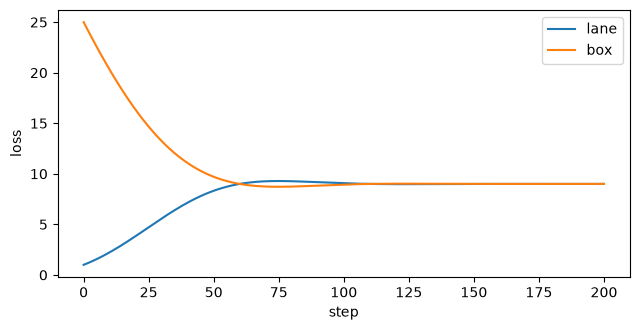
The targets are 1.0 and -5.0. The closed form for the sum is w = -2.0000.
Step 0 is w = 0.0000, lane loss 1.0000, box loss 25.0000. After one step, w is -0.0500, lane loss is 1.1025, and box loss is 24.5025. The small loss has already gone up.
At step 200, w is -1.9999, lane loss is 8.9996, and box loss is 9.0004. The lane curve rises and the box curve falls until they meet near 9. The summed loss found a compromise, not either target. That is what section 1's bar chart warned about: the quiet task gets worse so the loud one can improve.
6. The volume knob (uncertainty weighting)
Section 1 turned a knob instead of accepting the drowning bar. The repo stores that knob as log_vars, one scalar per task. Write . The loss adds for each task loss . The weight on is , which shrinks when grows — the loud task is turned down. The term grows with , so the knob cannot run away to infinity. This is not a second network; it is four scalars beside the heads.
Kendall, Gal, and Cipolla derive that form from Gaussian task noise. Here lane BCE, freespace BCE, vehicle MSE, and traffic-light cross-entropy all pass through the same recipe.
Predict: with lane loss 0.3, box loss 40, and both , the box term is most of the total. At box that term should drop, and UncertaintyMultiTaskLoss should match the hand formula.
lane_L = torch.tensor(0.3)
box_L = torch.tensor(40.0)
print(f"{'s':>6} {'L':>8} {'weight':>10} {'penalty':>10} {'term':>12}")
for s_box in (0.0, 2.0, 4.0):
    s = torch.tensor([0.0, s_box])
    hand_terms = []
    for i, loss_i in enumerate((lane_L, box_L)):
        weight = 0.5 * torch.exp(-s[i])
        penalty = 0.5 * s[i]
        term = weight * loss_i + penalty
        hand_terms.append(term)
        print(
            f"{s[i].item():6.1f} {loss_i.item():8.1f} {weight.item():10.6f} "
            f"{penalty.item():10.4f} {term.item():12.6f}"
        )
    loss_mod = UncertaintyMultiTaskLoss(2)
    with torch.no_grad():
        loss_mod.log_vars.copy_(s)
    repo_total = loss_mod([lane_L, box_L])
    hand_total = hand_terms[0] + hand_terms[1]
    print("repo total", f"{repo_total.item():.6f}", "hand total", f"{hand_total.item():.6f}")
    assert torch.allclose(repo_total, hand_total, atol=1e-5)
    sigma = torch.exp(0.5 * s[1])
    kendall = box_L / (2 * sigma ** 2) + torch.log(sigma)
    repo_box = hand_terms[1]
    print("kendall box", f"{kendall.item():.6f}", "repo box", f"{repo_box.item():.6f}")
    assert torch.allclose(kendall, repo_box, atol=1e-5)

fresh = UncertaintyMultiTaskLoss(4)
print("initial weights", [f"{w:.4f}" for w in fresh.get_task_weights()])

L = 40.0
s_star = torch.tensor(L).log()
weight_star = 0.5 * torch.exp(-s_star)
penalty_star = 0.5 * s_star
term_star = weight_star * L + penalty_star
print("s*", f"{s_star.item():.4f}")
print("weight*", f"{weight_star.item():.6f}")
print("penalty*", f"{penalty_star.item():.4f}")
print("term*", f"{term_star.item():.4f}")
for s_value in (0.0, 4.0, float(s_star)):
    deriv = 0.5 - 0.5 * torch.exp(torch.tensor(-s_value)) * L
    print("d/ds", f"{s_value:.4f}", f"{deriv.item():.4f}")
     s        L     weight    penalty         term
   0.0      0.3   0.500000     0.0000     0.150000
   0.0     40.0   0.500000     0.0000    20.000000
repo total 20.150000 hand total 20.150000
kendall box 20.000000 repo box 20.000000
   0.0      0.3   0.500000     0.0000     0.150000
   2.0     40.0   0.067668     1.0000     3.706706
repo total 3.856706 hand total 3.856706
kendall box 3.706706 repo box 3.706706
   0.0      0.3   0.500000     0.0000     0.150000
   4.0     40.0   0.009158     2.0000     2.366313
repo total 2.516313 hand total 2.516313
kendall box 2.366313 repo box 2.366313
initial weights ['0.5000', '0.5000', '0.5000', '0.5000']
s* 3.6889
weight* 0.012500
penalty* 1.8444
term* 2.3444
d/ds 0.0000 -19.5000
d/ds 4.0000 0.1337
d/ds 3.6889 0.0000
At the lane row is weight 0.500000, penalty 0.0000, term 0.150000. The box row is weight 0.500000, penalty 0.0000, term 20.000000. Repo total and hand total both read 20.150000. The box term is the total — the same drowning shape as section 1, now in formula form.
At box the box weight is 0.009158, the penalty is 2.0000, and the term is 2.366313. Repo total is 2.516313. Raising cut the box term from 20.000000 to 2.366313; the penalty climbed to 2.0000.
A fresh four-task loss prints initial weights 0.5000 four times. For the stationary is 3.6889, weight 0.012500, penalty 1.8444, term 2.3444. The derivative is -19.5000 at (turn the knob up), 0.1337 at (turn it down), and 0.0000 at .
Same stem batch as section 1: the bar chart numbers, plotted again after the formula.
Predict: lane share after weighting is still 10.11 percent and vehicle share is 89.89 percent.
fig, ax = plt.subplots(figsize=(7, 3.8))
labels = ["before weighting", "after volume knob"]
x = np.arange(len(labels))
width = 0.35
ax.bar(x - width / 2, [lane_share, lane_share_w], width, label="lane")
ax.bar(x + width / 2, [veh_share, veh_share_w], width, label="vehicle")
ax.set_ylabel("percent of stem gradient")
ax.set_title("How much of the shared-trunk update each job owns")
ax.set_xticks(x, labels)
ax.legend()
plt.tight_layout()
plt.show()
print("lane share before", f"{lane_share:.2f}", "after", f"{lane_share_w:.2f}")
print("vehicle share before", f"{veh_share:.2f}", "after", f"{veh_share_w:.2f}")
lane share before 0.34 after 10.11
vehicle share before 99.66 after 89.89
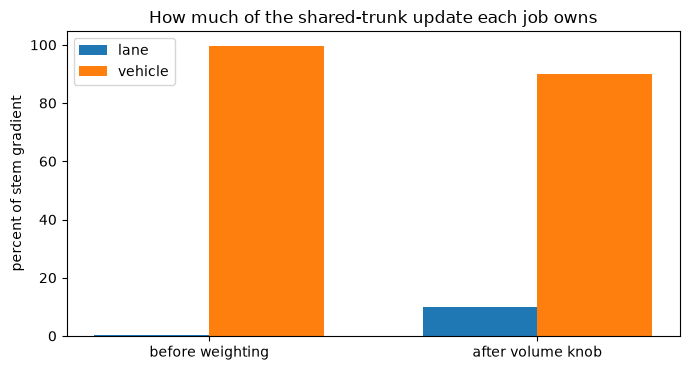
The second bar group matches section 1: lane moves from 0.34 to 10.11 percent; vehicle moves from 99.66 to 89.89 percent. The knob rebalanced the stem; it did not erase the vehicle head's scale advantage in one setting.
7. Separate heads, shared trunk
HydraNet gives each job its own head, so both targets can improve at once. Toy version: shared linear trunk of 16 units, lane targets with std near 1, box targets scaled by 4. Train 80 Adam steps at learning rate 0.01, once with a plain sum and once with UncertaintyMultiTaskLoss(2).
Predict: under the repo loss, both lane MSE and box MSE are smaller at step 80 than at step 1. The box weight should end below its start of 0.5.
torch.manual_seed(0)
n_rows, n_in, n_hid = 128, 8, 16
x_toy = torch.randn(n_rows, n_in)
y_lane = (x_toy @ torch.randn(n_in, 1)) * 0.3
y_box = (x_toy @ torch.randn(n_in, 1)) * 4.0
print("learning rate", f"{1e-2:.2f}")
print("steps", 80)
print("lane target std", f"{y_lane.std().item():.4f}")
print("box target std", f"{y_box.std().item():.4f}")

class TwoHead(nn.Module):
    def __init__(self):
        super().__init__()
        self.trunk = nn.Linear(n_in, n_hid)
        self.lane = nn.Linear(n_hid, 1)
        self.box = nn.Linear(n_hid, 1)

    def forward(self, z):
        h = torch.relu(self.trunk(z))
        return self.lane(h), self.box(h)

def run_two_head(mode, steps=80, lr=1e-2):
    torch.manual_seed(1)
    net = TwoHead()
    loss_mod = UncertaintyMultiTaskLoss(2) if mode == "unc" else None
    params = list(net.parameters())
    if loss_mod is not None:
        params = params + list(loss_mod.parameters())
    opt = torch.optim.Adam(params, lr=lr)
    lane_hist, box_hist = [], []
    for step in range(1, steps + 1):
        opt.zero_grad()
        pred_lane, pred_box = net(x_toy)
        loss_lane = F.mse_loss(pred_lane, y_lane)
        loss_box = F.mse_loss(pred_box, y_box)
        lane_hist.append(loss_lane.item())
        box_hist.append(loss_box.item())
        if step in (1, steps):
            if loss_mod is None:
                g_l = torch.autograd.grad(loss_lane, net.trunk.weight, retain_graph=True)[0].norm().item()
                g_b = torch.autograd.grad(loss_box, net.trunk.weight, retain_graph=True)[0].norm().item()
                share = 100.0 * g_l / (g_l + g_b)
                weight_txt = "none"
            else:
                wt = loss_mod.get_task_weights()
                g_l = torch.autograd.grad(wt[0] * loss_lane, net.trunk.weight, retain_graph=True)[0].norm().item()
                g_b = torch.autograd.grad(wt[1] * loss_box, net.trunk.weight, retain_graph=True)[0].norm().item()
                share = 100.0 * g_l / (g_l + g_b)
                weight_txt = [f"{v:.4f}" for v in wt]
            print(
                mode,
                "step", step,
                "lane", f"{loss_lane.item():.4f}",
                "box", f"{loss_box.item():.4f}",
                "lane_share", f"{share:.1f}",
                "weights", weight_txt,
            )
        total = loss_lane + loss_box if loss_mod is None else loss_mod([loss_lane, loss_box])
        total.backward()
        opt.step()
    return lane_hist, box_hist

naive_lane, naive_box = run_two_head("naive")
unc_lane, unc_box = run_two_head("unc")
assert unc_lane[-1] < unc_lane[0]
assert unc_box[-1] < unc_box[0]
assert naive_lane[-1] < naive_lane[0]
assert naive_box[-1] < naive_box[0]

fig, axes = plt.subplots(1, 2, figsize=(9, 3.4))
axes[0].plot(naive_lane, label="lane")
axes[0].plot(naive_box, label="box")
axes[0].set_title("plain sum")
axes[1].plot(unc_lane, label="lane")
axes[1].plot(unc_box, label="box")
axes[1].set_title("UncertaintyMultiTaskLoss")
for ax in axes:
    ax.set_xlabel("step")
    ax.set_ylabel("MSE")
    ax.legend()
plt.tight_layout()
plt.show()
learning rate 0.01
steps 80
lane target std 1.0617
box target std 13.1843
naive step 1 lane 1.2728 box 172.8219 lane_share 8.8 weights none
naive step 80 lane 0.2427 box 9.3208 lane_share 6.0 weights none
unc step 1 lane 1.2728 box 172.8219 lane_share 8.8 weights ['0.5000', '0.5000']
unc step 80 lane 0.1066 box 11.2656 lane_share 10.3 weights ['1.0520', '0.3058']
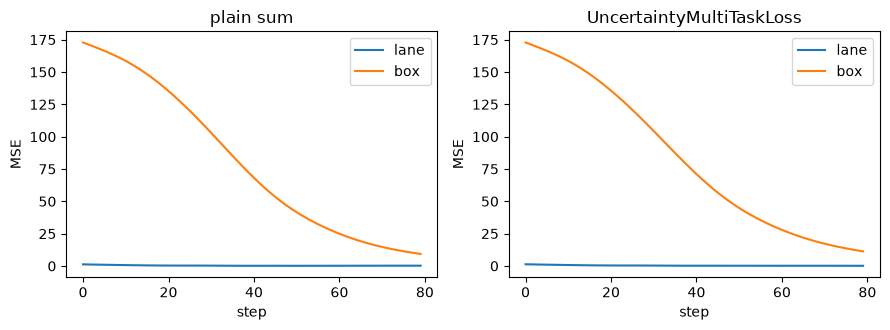
Lane target std is 1.0617. Box target std is 13.1843.
Plain sum, step 1: lane 1.2728, box 172.8219, lane share of the trunk gradient 8.8. Step 80: lane 0.2427, box 9.3208, lane share 6.0. Both losses fell; the trunk gradient stayed mostly the box task.
Repo loss, step 1: lane 1.2728, box 172.8219, weights 0.5000 and 0.5000, lane share 8.8. Step 80: lane 0.1066, box 11.2656, weights 1.0520 and 0.3058, lane share 10.3. Both losses fell. The box weight moved from 0.5000 to 0.3058. Lane ended lower than the plain sum (0.1066 vs 0.2427); box ended higher (11.2656 vs 9.3208). Separate heads are why both can fall; section 5's single knob had no such room.
8. Ten steps on the real HydraNet
One fixed synthetic batch, 10 steps. Optimizer matches train_hydranet.py: AdamW, learning rate 2e-3, weight decay 1e-4, on the network and on log_vars. Losses are lane BCE, freespace BCE, vehicle MSE times 10, and traffic-light cross-entropy. The batch does not change between steps.
Predict: lane BCE and traffic-light cross-entropy drop. The vehicle weight moves only a little in 10 steps. Freespace, which starts near , barely moves.
torch.manual_seed(0)
images = torch.randn(2, 3, 128, 256)
gt_lane = (torch.rand(2, 1, 128, 256) > 0.92).float()
gt_free = (torch.rand(2, 1, 128, 256) > 0.50).float()
gt_veh = torch.randn(2, 5, 16, 32)
gt_tl = torch.randint(0, 4, (2,))

torch.manual_seed(1)
model = HydraNet()
loss_balancer = UncertaintyMultiTaskLoss(4)
optimizer = torch.optim.AdamW(
    list(model.parameters()) + list(loss_balancer.parameters()),
    lr=2e-3,
    weight_decay=1e-4,
)
print("steps", 10)
print("lr", "2e-3")
print("weight decay", "1e-4")
print("init weights", [f"{w:.4f}" for w in loss_balancer.get_task_weights()])
raw_hist = []
for step in range(1, 11):
    optimizer.zero_grad()
    preds = model(images)
    task = [
        F.binary_cross_entropy_with_logits(preds["lane"], gt_lane),
        F.binary_cross_entropy_with_logits(preds["freespace"], gt_free),
        F.mse_loss(preds["vehicles"], gt_veh) * 10.0,
        F.cross_entropy(preds["traffic_light"], gt_tl),
    ]
    total = loss_balancer(task)
    total.backward()
    optimizer.step()
    raw_hist.append([t.item() for t in task])
    ws = [f"{w:.4f}" for w in loss_balancer.get_task_weights()]
    print(
        f"{step:2d}",
        "total", f"{total.item():.4f}",
        "lane", f"{task[0].item():.4f}",
        "free", f"{task[1].item():.4f}",
        "veh", f"{task[2].item():.4f}",
        "tl", f"{task[3].item():.4f}",
        "w", ws,
    )

assert raw_hist[-1][0] < raw_hist[0][0]
assert raw_hist[-1][2] < raw_hist[0][2]
assert raw_hist[-1][3] < raw_hist[0][3]
assert abs(raw_hist[0][1] - raw_hist[-1][1]) < 0.1
steps 10
lr 2e-3
weight decay 1e-4
init weights ['0.5000', '0.5000', '0.5000', '0.5000']
 1 total 6.9986 lane 0.7817 free 0.6935 veh 11.1095 tl 1.4125 w ['0.5010', '0.5010', '0.4990', '0.4990']
 2 total 10.1012 lane 0.6909 free 0.6928 veh 17.6377 tl 1.2159 w ['0.5020', '0.5020', '0.4980', '0.4981']
 3 total 5.7843 lane 0.4506 free 0.6923 veh 9.3911 tl 1.0715 w ['0.5030', '0.5030', '0.4971', '0.4973']
 4 total 5.6299 lane 0.3187 free 0.6916 veh 9.3417 tl 0.9622 w ['0.5039', '0.5040', '0.4961', '0.4967']
 5 total 5.6379 lane 0.3976 free 0.6907 veh 9.3804 tl 0.8780 w ['0.5049', '0.5050', '0.4952', '0.4963']
 6 total 5.4834 lane 0.3225 free 0.6896 veh 9.2285 tl 0.8133 w ['0.5059', '0.5060', '0.4943', '0.4962']
 7 total 5.2623 lane 0.2893 free 0.6880 veh 8.8888 tl 0.7586 w ['0.5070', '0.5070', '0.4934', '0.4964']
 8 total 5.0189 lane 0.3123 free 0.6859 veh 8.4372 tl 0.7122 w ['0.5080', '0.5081', '0.4925', '0.4967']
 9 total 4.8499 lane 0.3223 free 0.6831 veh 8.1418 tl 0.6732 w ['0.5090', '0.5091', '0.4916', '0.4972']
10 total 4.6150 lane 0.3103 free 0.6797 veh 7.7280 tl 0.6408 w ['0.5101', '0.5101', '0.4907', '0.4978']
Initial weights are 0.5000 four times.
Step 1: total 6.9986, lane 0.7817, freespace 0.6935, vehicle 11.1095, traffic light 1.4125, weights 0.5010 0.5010 0.4990 0.4990.
Step 2 jumps: total 10.1012, vehicle 17.6377. The walk is not monotone.
Step 10: total 4.6150, lane 0.3103, freespace 0.6797, vehicle 7.7280, traffic light 0.6408, weights 0.5101 0.5101 0.4907 0.4978.
Lane BCE fell from 0.7817 to 0.3103. Traffic light fell from 1.4125 to 0.6408. Vehicle MSE times 10 fell from 11.1095 to 7.7280 after that spike. Freespace moved from 0.6935 to 0.6797. The vehicle weight moved from 0.5000 to 0.4907. Ten steps on synthetic noise means memorization, not road readiness — but the four scalars are already drifting with the loudest tasks.
9. Exercises
Three checks taken from modules/02_hydranet/tests/test_hydranet.py. Leave each TODO in place to use the reference. Replace it if you want the check to call your function.
Exercise — output shapes. Return the five output shapes for a batch, matching test_output_head_shapes. Keys: lane, freespace, vehicles, traffic_light, backbone_features.
def expected_shapes_student(batch, height, width):
    # TODO: dict of output name -> shape tuple
    raise NotImplementedError

def expected_shapes_reference(batch, height, width):
    return {
        "lane": (batch, 1, height, width),
        "freespace": (batch, 1, height, width),
        "vehicles": (batch, 5, height // 8, width // 8),
        "traffic_light": (batch, 4),
        "backbone_features": (batch, 128, height // 8, width // 8),
    }

def get_shapes_fn():
    try:
        expected_shapes_student(2, 128, 256)
    except NotImplementedError:
        print("Using reference expected_shapes (TODO not implemented)")
        return expected_shapes_reference
    print("Using your expected_shapes")
    return expected_shapes_student

shapes_fn = get_shapes_fn()
torch.manual_seed(0)
live = HydraNet()(torch.randn(2, 3, 128, 256))
shapes = shapes_fn(2, 128, 256)
for key, expected in shapes.items():
    got = tuple(live[key].shape)
    print(key, got)
    assert got == tuple(expected)
print("✅ correct: head shapes match the live HydraNet")
Using reference expected_shapes (TODO not implemented)
lane (2, 1, 128, 256)
freespace (2, 1, 128, 256)
vehicles (2, 5, 16, 32)
traffic_light (2, 4)
backbone_features (2, 128, 16, 32)
✅ correct: head shapes match the live HydraNet
The check prints ✅. The live forward is lane (2, 1, 128, 256), freespace (2, 1, 128, 256), vehicles (2, 5, 16, 32), traffic light (2, 4), and backbone_features (2, 128, 16, 32). The reference is used because the TODO still raises.
Solution
return {
    "lane": (batch, 1, height, width),
    "freespace": (batch, 1, height, width),
    "vehicles": (batch, 5, height // 8, width // 8),
    "traffic_light": (batch, 4),
    "backbone_features": (batch, 128, height // 8, width // 8),
}
Exercise — stem gradient. test_gradient_flow_to_shared_trunk sums the traffic-light logits, calls backward, and checks that backbone.stem[0].weight.grad exists and is finite. Return that boolean.
def traffic_light_reaches_stem_student(model, images):
    # TODO: backward on traffic_light only; return True if stem grad is finite
    raise NotImplementedError

def traffic_light_reaches_stem_reference(model, images):
    preds = model(images)
    model.zero_grad()
    preds["traffic_light"].sum().backward()
    grad = model.backbone.stem[0].weight.grad
    return grad is not None and bool(torch.isfinite(grad).all())

def get_stem_fn():
    try:
        traffic_light_reaches_stem_student(None, None)
    except NotImplementedError:
        print("Using reference stem check (TODO not implemented)")
        return traffic_light_reaches_stem_reference
    print("Using your stem check")
    return traffic_light_reaches_stem_student

stem_fn = get_stem_fn()
torch.manual_seed(0)
ex_model = HydraNet()
ex_images = torch.randn(2, 3, 128, 256)
ok = stem_fn(ex_model, ex_images)
grad = ex_model.backbone.stem[0].weight.grad
print("stem grad finite", ok)
print("stem grad shape", tuple(grad.shape))
print("stem grad norm", f"{grad.norm().item():.6f}")
assert ok is True
print("✅ correct: traffic-light loss reaches the shared stem")
Using reference stem check (TODO not implemented)
stem grad finite True
stem grad shape (32, 3, 3, 3)
stem grad norm 0.190363
✅ correct: traffic-light loss reaches the shared stem
The check prints ✅. stem grad finite is True. The gradient shape is (32, 3, 3, 3), and its norm is 0.190363. Traffic-light pooling still reaches the shared cook. The reference is used because the TODO still raises.
Solution
preds = model(images)
model.zero_grad()
preds["traffic_light"].sum().backward()
grad = model.backbone.stem[0].weight.grad
return grad is not None and bool(torch.isfinite(grad).all())
Exercise — uncertainty total. Implement one call of the repo formula: for each task, , summed. test_uncertainty_loss_properties builds UncertaintyMultiTaskLoss(4) on losses 1, 2, 3, 4 and checks that log_vars.grad has shape (4,).
def uncertainty_total_student(task_losses, log_vars):
    # TODO: sum over tasks of 0.5 * exp(-s) * L + 0.5 * s
    raise NotImplementedError

def uncertainty_total_reference(task_losses, log_vars):
    total = task_losses[0] * 0.0
    for i, loss in enumerate(task_losses):
        s = log_vars[i]
        total = total + 0.5 * torch.exp(-s) * loss + 0.5 * s
    return total

def get_loss_fn():
    try:
        uncertainty_total_student([torch.tensor(1.0)], torch.zeros(1))
    except NotImplementedError:
        print("Using reference uncertainty total (TODO not implemented)")
        return uncertainty_total_reference
    print("Using your uncertainty total")
    return uncertainty_total_student

loss_fn = get_loss_fn()
task_losses = [torch.tensor(float(v)) for v in (1.0, 2.0, 3.0, 4.0)]
hand = loss_fn(task_losses, torch.zeros(4))
repo = UncertaintyMultiTaskLoss(4)
repo_total = repo(task_losses)
print("hand total", f"{hand.item():.4f}")
print("repo total", f"{repo_total.item():.4f}")
assert torch.allclose(hand, repo_total, atol=1e-5)
repo_total.backward()
print("log_vars.grad", [f"{g:.4f}" for g in repo.log_vars.grad.tolist()])
print("grad shape", tuple(repo.log_vars.grad.shape))
assert tuple(repo.log_vars.grad.shape) == (4,)
print("✅ correct: uncertainty total matches UncertaintyMultiTaskLoss")
Using reference uncertainty total (TODO not implemented)
hand total 5.0000
repo total 5.0000
log_vars.grad ['0.0000', '-0.5000', '-1.0000', '-1.5000']
grad shape (4,)
✅ correct: uncertainty total matches UncertaintyMultiTaskLoss
The check prints ✅. Hand total and repo total are both 5.0000 (half of 1+2+3+4, because every weight starts at 0.5). log_vars.grad is 0.0000 -0.5000 -1.0000 -1.5000, and grad shape is (4,). The reference is used because the TODO still raises.
Solution
total = task_losses[0] * 0.0
for i, loss in enumerate(task_losses):
    s = log_vars[i]
    total = total + 0.5 * torch.exp(-s) * loss + 0.5 * s
return total
10. Recap
- One cook, four dishes: lane, freespace, vehicles, traffic light from one trunk forward.
- On a batch
(2, 3, 128, 256)the pyramid isp1(2, 32, 64, 128),p2(2, 64, 32, 64),p3(2, 128, 16, 32). - Three separate models are
1213450parameters. One trunk plus three heads is635850, ratio1.9084. FullHydraNetis808011instead of1674411. - Before weighting, lane owns
0.34percent of the stem gradient and vehicle owns99.66percent on the seed-42 batch. After vehiclelog_vars = 3.5, those shares become10.11and89.89. - A shared knob with losses
(w-1)^2and(w+5)^2walks tow = -1.9999. Lane loss goes from1.0000to8.9996. Box loss goes from25.0000to9.0004. - The repo loss is with . For losses
0.3and40at , the total is20.150000, and the box term is20.000000of it. Stationary box noise is . - With separate heads, toy losses fall under that loss: lane
1.2728to0.1066, box172.8219to11.2656. Ten HydraNet steps on one batch move lane BCE from0.7817to0.3103and vehicle weight from0.5000to0.4907.
Paper
Kendall, Gal, and Cipolla, Multi-Task Learning Using Uncertainty to Weigh Losses for Scene Geometry and Semantics, CVPR 2018. arXiv:1705.07115